On the other hand, this Seeing-Thinking Activity, produced and promoted by the NYT looks to be both an excellent resource and a lot of fun!
https://learning.blogs.nytimes.com/2015/02/27/10-intriguing-photographs-to-teach-close-reading-and-visual-thinking-skills/
Thursday, August 2, 2018

Thinking about critical thinking skills
Making predictions is good. It can even be a lot of fun. So why does the method of teaching children to think about what they are reading (DR-TA) feel so cumbersome and legalistic?
1. cf C.S. Lewis's looking along the beam vs. looking at the beam. This seems to take materials that are meant to be looked *along*, to be enjoyed, and to turn them into something to be looked *at*, at a possibly developmentally inappropriate stage.
2. It increases for the students the sense that there is right and wrong as regards prediction and interactions with texts. Conflating accurate / inaccurate with moral / immoral.
3. It becomes cumbersome and tedious to children who predict automatically and accurately, slowing down and interfering with the actual enjoyment of the book.
4. For children's books which may operate with an element of surprise (many), it functions to ruin the joke by explaining the joke. (Q: Tell me class, why did the author do this? A: To be silly. To make me laugh.)
5. The focusing on the "what" obscures the "how." Better questions: Did you like what happened? Would you have done the same thing?
Critical idea: give children "ownership" of their literature . . . let them be free to stand over it in judgement, not just under it, needing to "get it right."
So, perhaps I believe that this method of evaluating is not appropriate to materials that are to be consumed in one sitting, or by children who are too young to critically evaluate? Maybe we should encourage young kids to wonder and let the wondering be?
1. cf C.S. Lewis's looking along the beam vs. looking at the beam. This seems to take materials that are meant to be looked *along*, to be enjoyed, and to turn them into something to be looked *at*, at a possibly developmentally inappropriate stage.
2. It increases for the students the sense that there is right and wrong as regards prediction and interactions with texts. Conflating accurate / inaccurate with moral / immoral.
3. It becomes cumbersome and tedious to children who predict automatically and accurately, slowing down and interfering with the actual enjoyment of the book.
4. For children's books which may operate with an element of surprise (many), it functions to ruin the joke by explaining the joke. (Q: Tell me class, why did the author do this? A: To be silly. To make me laugh.)
5. The focusing on the "what" obscures the "how." Better questions: Did you like what happened? Would you have done the same thing?
Critical idea: give children "ownership" of their literature . . . let them be free to stand over it in judgement, not just under it, needing to "get it right."
So, perhaps I believe that this method of evaluating is not appropriate to materials that are to be consumed in one sitting, or by children who are too young to critically evaluate? Maybe we should encourage young kids to wonder and let the wondering be?
Saturday, January 6, 2018
King's Cake, 2018: Well, THAT was a success
Since I never follow the recipe, and don't always remember how I adjusted what, here are this year's notes on what I did with the recipe and how it worked:
I used regular butter and 1/4 c LF milk. I cut the sugar in the dough down from 3 TBSP to 1 TBSP. For the filling, I used 1/2 c dark brown sugar, 2 tsp cinnamon and 1/2 c chopped walnuts. The dough was quite crumbly, but patchable. The recipe calls for rolling it out into a 10" x 30" rectangle. I think it could have gone that far . . . but it would have been impossible to jelly roll at that point. I rolled it into a 12" x 18" rectangle and then jelly rolled it with a silicon baking mat. It didn't handle well at all when I tried to shape the log into a circle. It just broke. We just baked the broken pieces. I let it rise about 15 minutes and then baked it for 20.
For glaze: ~ 1 cup powdered sugar with 3 TBSP lemon juice and 3 TBSP water. Colored green and gold sugar, and some of the glaze with purple food coloring.
Flavor and texture with this "cake" was phenomenal. The dough was almost like pie crust in richness and flakiness. The balance of spice, sweetness and tang with the cinnamon, nutmeg and lemon in the glaze was great. No worries about this one not being pretty . . . it didn't last long enough to matter.
* * *
I used regular butter and 1/4 c LF milk. I cut the sugar in the dough down from 3 TBSP to 1 TBSP. For the filling, I used 1/2 c dark brown sugar, 2 tsp cinnamon and 1/2 c chopped walnuts. The dough was quite crumbly, but patchable. The recipe calls for rolling it out into a 10" x 30" rectangle. I think it could have gone that far . . . but it would have been impossible to jelly roll at that point. I rolled it into a 12" x 18" rectangle and then jelly rolled it with a silicon baking mat. It didn't handle well at all when I tried to shape the log into a circle. It just broke. We just baked the broken pieces. I let it rise about 15 minutes and then baked it for 20.
For glaze: ~ 1 cup powdered sugar with 3 TBSP lemon juice and 3 TBSP water. Colored green and gold sugar, and some of the glaze with purple food coloring.
Flavor and texture with this "cake" was phenomenal. The dough was almost like pie crust in richness and flakiness. The balance of spice, sweetness and tang with the cinnamon, nutmeg and lemon in the glaze was great. No worries about this one not being pretty . . . it didn't last long enough to matter.
* * *
Gluten
Free Kings Cake
INGREDIENTS:
§
¼ to ½ cup warm water
(110 F)
§ 1 Tbs.
granulated cane sugar
§ 1 TBSP
yeast
§ ½ cup unsalted butter or non-dairy alternative (coconut
oil)
- 1/8 to ¼ cup warm milk (dairy or non-dairy)
- 2 large eggs (room temperature)
- 3 cups GF flour
- ½ tsp. ground
nutmeg
- 2 tsp. baking powder
- ½ tsp. salt
- 2 Tbs. milk (dairy or non-dairy) for brushing on pastry
before baking (or egg wash?) (optional)
§ Filling
Ingredients:
- ¾ cup packed
light brown sugar
- 1 ½ tsp. ground
cinnamon
- ¼ cup flour (optional)
- 1 apple, peeled and chopped (optional)
- 2/3 cup chopped
pecans (optional)
METHOD:
Prepare
the filling by tossing the chopped apples together with the flour, brown
sugar and cinnamon. In a separate bowl, melt the 4 tablespoons butter, and set
both bowls aside.
In a
small bowl, combine the warm water, 1 tablespoon sugar and yeast; stir and set
aside to proof. If the mixture is not bubbly and doubled in volume after 5-10
minutes, toss out and start again with fresh yeast.
In a
large mixing bowl, blend the remaining 3 tablespoons sugar and butter until
light and fluffy. Add the milk and eggs and beat until well-integrated.
Add only 2 cups of flour, salt, baking powder and nutmeg and mix well. Stir in
the proofed yeast-sugar-water mixture, then add the remaining 1 cup flour. Beat
another 1-2 minutes, until the dough is clumping together and is not too
sticky.
Prepare
a large baking sheet by lining with parchment paper. Turn the dough out onto a
silicone pastry mat or onto a clean counter dusted lightly with flour (be sure
to have enough counter space, at least 30 inches wide).
Roll
the dough out to an elongated rectangle 24-30 inches long by 9-10 inches wide.
Brush on the melted butter, coating the entire rectangle.
Sprinkle
the filling mixture on top of the melted butter, spreading to the ends of the
rectangle, but leaving 1/2-1 inch without toppings on each of the long sides of
the rectangle.
Using a
bench scraper or a spatula, gently peel up one of the long sides of the
rectangle and begin rolling it as you would a jelly roll. Once the entire
pastry is rolled upon itself until no pastry remains unrolled, a 24-30 inch
long roll will remain. Gently pull the two ends of the roll together to form a
circle or oval.
Dabbing
the ends of the pastry with water, join the ends together to close the circle.
Gently transfer the ring to the parchment-lined baking sheet, or transfer the
ring on the silicone baking mat to the baking sheet.
Brush
the milk on top of the exposed pastry, then using a large sharp knife, make a
cut in the top of the pastry every 2 inches to expose one layer of the roll.
Spray a
sheet of wax paper with cooking oil, then cover the cake and let rise in a warm
spot for 20-30 minutes like a warming drawer or an oven heated to 200º F then
turned off.
Preheat
oven to 350º F (static)
Remove
the wax paper from the cake and bake for 20-25 minutes.
Wednesday, August 5, 2015
Eight lifetimes
I find this fascinating. Stashing here so I can increase the chances that I can actually find it later when I'm actually looking for it.
Eight Lifetimes
Eight Lifetimes
Thursday, July 30, 2015
Language chart
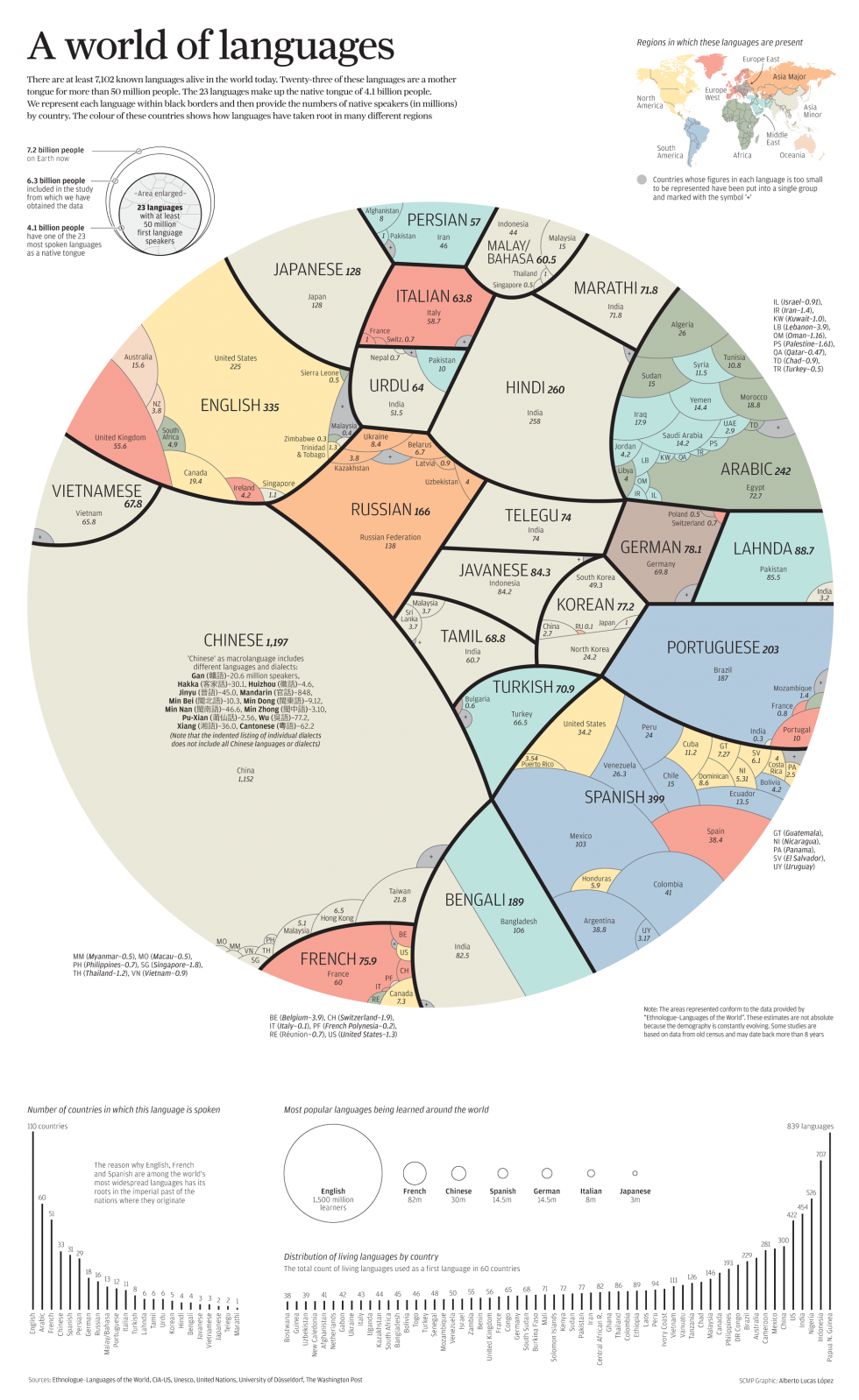
Cool!
Languages by number of speakers worldwide.
I do wonder how closely related the Chinese dialects are to each other, and if, for example, we could lump Spanish, Portuguese, French and Italian together the same way . .
Sunday, June 28, 2015
Cable Salad
Okay, so it's Cracked.com. Language warning. But I love reading about cliches, proverbs and vocabulary from other languages . . . just skip the first and last.
31 phrases English needs to steal
31 phrases English needs to steal
Saturday, June 27, 2015
musings prompted by bearing
Here, Bearing makes connections between Pope Benedict's encyclical and a Japanese book on decluttering. It's much less far fetched than you might think. But I was particularly struck by these two paragraphs.
This in turn doubles back to much of what Ann Voskamp has written on gratitude.
Given my fractious feelings with regards to patriotism and the American flag the last number of years, I like the handle that this gives.
I also think that it's interesting that *what* we respect is an indicator of what we are *grateful* for . . . somehow this all doubles back and relates to idolatry and desire . . . we are grateful for that which we deem to hold worth. What we *worship* . . .
Is the divide between the right and the left in large part a choice of different idols? That what we value as worthy of opposed?
Bearing's original post
Some of what St. Francis was getting at, when he preached to birds and addressed "brother sun, sister moon," is gratitude. Because that is what a Catholic vision of "respect for the natural world" must, in the end, be reduced to. Respect is actually something owed to persons, and all "respect" for objects, natural or man-made, is really a respect for persons; the object is merely a means of transmission. Example: we show respect for, say, an American flag, not for its own sake, but because it's a way to visibly respect people who also share that flag, sometimes (as at a military funeral) very specific people.
And we "respect" the natural world, not for its own sake, but (practically speaking) to steward it and share it for the sake of other people's livelihood, and (more fundamentally speaking) out of gratitude to God for making a gift of it to all of us. Wastefulness and an attitude of total control risk us taking for granted this world of objects for which we should give thanks every day.
This in turn doubles back to much of what Ann Voskamp has written on gratitude.
Given my fractious feelings with regards to patriotism and the American flag the last number of years, I like the handle that this gives.
I also think that it's interesting that *what* we respect is an indicator of what we are *grateful* for . . . somehow this all doubles back and relates to idolatry and desire . . . we are grateful for that which we deem to hold worth. What we *worship* . . .
Is the divide between the right and the left in large part a choice of different idols? That what we value as worthy of opposed?
Bearing's original post
Subscribe to:
Posts (Atom)